
 Agentic AI thrives in dynamic, exception-rich environments – but only when processes are well-understood and modeled. Process modeling and simulation prepare organizations for every stage of AI maturity – from today’s automation and GenAI to tomorrow’s Agentic AI – by testing scenarios, predicting outcomes, and building resilient, adaptable processes.
The Part Everyone Skips: Designing the Future Before You Automate It
Most companies approach automation and AI the same way people approach assembling furniture without the instructions:
Step 1: Assume it’s obvious.
Step 2: Realize it’s not.
Step 3: Blame the furniture.
With AI, the stakes are higher.
Executives install AI into messy, undocumented workflows and act surprised when the results look like the workflow itself – just faster and with more confidence than any human would dare.
Future-state design isn’t about making today’s process slightly faster. It’s your chance to redesign the business entirely: to eliminate outdated steps, restructure decision logic, and build the operating model you actually want AI to run.
AI rewards reinvention, not preservation.
The truth is simple: Before AI can run your business, you have to design the business you want AI to run. That design comes from modeling and simulation – two steps that sound boring until you realize they are the difference between scaling intelligence and scaling chaos.
The Big Shift: Processes Must Evolve as AI Evolves
AI changes what your processes have to be capable of.
As organizations move from simple automation to GenAI and eventually to Agentic AI, the process environment must evolve with it. Early-stage automation can survive rigid, linear workflows – but advanced AI cannot. The more intelligence you apply, the less tolerance there is for unclear logic, hidden workarounds, and undocumented decisions.
AI becomes more powerful, but also less forgiving.
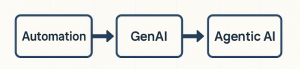
- Automation needs stable rules.
- GenAI requires flexible guardrails and context.
- Agentic AI thrives in environments full of exceptions and unpredictable decision points.
The problem? Most organizations still design processes as if they live inside a textbook – clean, linear, and perfectly rational.
Real processes have detours, improvisation, tribal shortcuts, and side quests no one documents. But AI doesn’t get the “unwritten rules” memo. If processes aren’t intentionally designed to handle variation, exceptions, and decision complexity, advanced AI will simply guess its way through them.
And AI guesses fast.
Process Modeling: The Blueprint for AI-Enabled Operations
If AI is expected to participate in (or fully run) a business process, it needs clarity about that process – clarity that rarely exists unless the future state is explicitly designed.
Modeling provides that design.
Modeling is also the moment to rethink the process itself – not just document it. Instead of polishing a legacy workflow, it allows you to challenge every step, redesign decision logic, remove obsolete work, and shape a process that’s actually worthy of automation or AI. It’s the opportunity to build the version of the business you wish you had, not the one you inherited.

It transforms tribal knowledge into an actual blueprint:
- Who owns what
- Where decisions happen
- What data is needed
- What the rules really are
- How exceptions route
- How compliance ties into execution
Modeling replaces “I think this is how it works” with “This is how it works, and here is how it should work.”
Future-state modeling also breaks organizational silos by showing how decisions in one department ripple across every other part of the business. AI needs this visibility – and executives need it even more – because it thrives on structure, not ambiguity.
Modeling provides the structure for AI to rely on, long before it writes its first recommendation or takes its first autonomous action.
Simulation: The Safe Sandbox for AI Planning
If modeling creates the blueprint, simulation is the test pilot.
It answers the questions that no meeting ever can:
- “What happens if we add AI here?”
- “Where will the bottleneck move?”
- “Will compliance break?”
- “Will customer wait times improve or get worse?”
- “What happens during a surge? A staffing dip? A new policy?”
- “What if AI handles exceptions instead of humans?”
 Simulation lets organizations test the future without risking the present. It exposes the chain reactions that automation and AI frequently trigger:
- A faster upstream step overloading a downstream team
- A new AI decision causing resource conflicts
- A GenAI-generated message increasing rework
- A change in routing logic creating compliance drift
In other words, simulation kills bad ideas before they become expensive mistakes. It’s the closest thing business leaders have to a “time machine.”
Preparing for Risk, Compliance, and Tradeoffs – Before AI Shows Up
No AI initiative should ever be built on hope. Processes need embedded clarity around risk, controls, and compliance – not as checklists, but as part of the operational design. When risk and controls are modeled alongside the workflow itself, teams can answer critical questions:
- Where can AI act autonomously?
- Where must humans remain in the loop?
- What controls must never be bypassed?
- How are approvals enforced?
- What decisions introduce regulatory exposure?
AI is powerful, but it should never “freestyle” its way through a high-risk decision.
Intentional modeling prevents that.
Simulation + Continuous Improvement: Adapt Before You Deploy
One of the biggest misunderstandings about AI is that it requires perfect processes.
It doesn’t.
It just requires processes that are designed to adapt – and simulation is what makes that possible.
With continuous simulation:
- You test changes.
- You learn the impact.
- You adjust the design.
- You validate the new state.
- Then you deploy AI.
It replaces the old model of:
Deploy → Discover problems → Panic → Fix later
with the new model:
Simulate → Fix before deployment → Deploy with confidence
This is how organizations move fast and stay in control.
A Practical Example: Finding Where AI Actually Delivers Value
A company wanted to keep up with competitors by “adding AI to fulfill orders faster.” Everyone assumed the manual review step was the bottleneck. They were prepared to automate it immediately…
But then they modeled the process and simulated it. The real bottleneck? Inventory reconciliation – a downstream operational choke point no one was talking about.
- Automating the review step barely improved throughput.
- Applying AI to reconcile mismatched data produced a dramatic improvement.
- Overall service levels increased without increasing risk.
Simulation didn’t just validate the idea. It redirected the idea – from “let’s add AI to this step” to “let’s add AI where it actually creates value.”
This is what happens when the future is designed before it is automated.
The Takeaway: Modeling and Simulation Are the Gateway to AI That Works
AI doesn’t magically fix broken processes. It amplifies whatever it touches.
Modeling and simulation make sure it amplifies intentional design – not accidental dysfunction.
They give leaders the power to:
- See the future before committing to it
- Predict outcomes with evidence
- Strengthen processes before AI joins them
- Build systems ready for dynamic, exception-rich environments
- Deploy AI confidently, safely, and strategically
AI is not the starting point.
It’s the accelerant.
The design comes first.
The simulation validates it.
And AI brings the well-designed future to life.
AI doesn’t transform your business.
Your redesigned processes do.
AI simply makes the new design unstoppable.
If you want to learn more about how iGrafx can prepare your business for Agentic AI excellence, book a personalized demo today.
This is the third blog in a 4-part blog series about process intelligence and AI readiness. You can find the rest of the blogs in the series in the links below:
Blog 1: Why Process Intelligence Is the Prerequisite for Agentic AI (and Every AI Ambition)
Blog 2: Don’t Automate Chaos: Why Fixing Broken Processes Comes Before Adding AI
Blog 4: Embedding Trust: Process-Level Risk and Compliance as the Backbone of AI Readiness