
The Hidden Weak Link in AI Ambition
The great irony of AI is that the smarter it gets, the less we seem to trust it.

For all the hype about machine learning, automation, and now Agentic AI, adoption in regulated industries continues to lag. It’s not because executives doubt the potential, it’s because they don’t trust the path to getting there.
As Forrester notes in its 2025 analysis of AI agents, “Trust is the primary challenge for AI agents.”1
Here’s the reality: until now, AI has mostly been applied to deterministic processes – predictable, repeatable, low-risk tasks. Yet even in those controlled domains, governance and compliance are often bolted on after the fact, if at all. Audit trails live in spreadsheets, version histories in SharePoint, and risk models in PowerPoint decks that no one updates.
Now, imagine applying the same fragmented approach when your AI begins handling exceptions, judgments, or autonomous decisions. That’s not just risky, it’s reckless.
Trust, in this new era, isn’t a compliance checkbox. It’s the operating system for responsible automation and building it starts long before your first AI pilot. It begins with process intelligence.
The Foundation: Process Intelligence with Embedded Risk and Compliance
We’ve long believed that Process Intelligence and Risk & Compliance aren’t separate disciplines – they’re two halves of the same brain. One analyzes and optimizes how your business runs; the other ensures it runs safely, ethically, and accountably.
That’s why risk and compliance aren’t “features.” They’re embedded into both the discovery and design of process architecture.
Whether you’re uncovering actual process behavior through mining systems data and checking for conformance to expected outcomes or designing operational-level controls and risk mitigation during process management and optimization – compliance needs to be built in, not added later.
When processes are modeled inside the Process Repository, the associated risks, controls, and compliance obligations are modeled alongside them. Every process, every policy, every control: connected. That’s how trust is built into the operational DNA of a business.
This embedded approach is why iGrafx has become a trusted backbone for banks, insurers, manufacturers, and logistics leaders – industries where a single deviation can have regulatory or financial consequences.
The Repository: The Single Source of Truth for Process Integrity
In most organizations, the documentation of process, risk, and compliance lives in silos.
Each department maintains its own view of the truth, and by the time audit season rolls around, the evidence trail looks like a patchwork quilt.
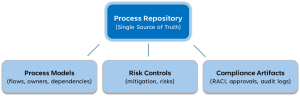 The Process Repository changes that dynamic completely. It becomes the single source of truth – not only for process models, but for the risk and compliance frameworks that govern them.
Here’s what that means in practice:
- Unified visibility: Every process model includes its associated risks, controls, and compliance mandates within the same system, with current data visible and reportable.
- Governed change: Updates are managed through formal governance lifecycles, with documented approvals, version histories, and RACI assignments – ensuring changes are deliberate, not automatic.
- Audit-ready confidence: Every revision is logged, traceable, and defensible. The repository isn’t just a design tool – it’s an audit record.
This is what “embedded” really means: not automatic, but accountable. In highly regulated environments, trust depends on knowing exactly who changed what, when, and why. When a process is approved, then entire interconnected set of information related to the process is kept in an auditable configuration. The repository ensures that history can’t be rewritten – and that’s precisely why auditors love it.
Turning Policy into Practice: The Process-Level Control Advantage
Most governance frameworks fail not in design, but in execution. Policies are well-documented, but they rarely become enforceable at the process level.
That’s where process-level risk and compliance modeling closes the loop.
When every process step that has a control is mapped to a control, and ownership is clearly identified, compliance becomes operational – not theoretical.
For example:
- In banking, approval workflows can be traced directly to risk controls and segregation-of-duties requirements.
- In manufacturing, safety and quality controls are tied to the actual production processes, ensuring compliance doesn’t rely on human memory.
- In logistics, regulatory steps for customs, safety, and chain-of-custody are captured in process models – providing a clear line from operational execution to compliance documentation.
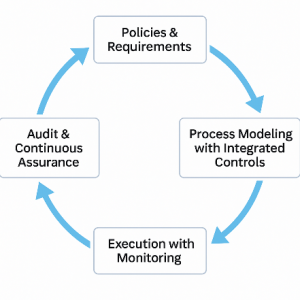 This approach transforms compliance from something checked later into something designed in.
The AI Imperative: From Reactive to Proactive Risk Management
As automation matures into Agentic AI – autonomous systems capable of taking initiative – the tolerance for ambiguity will vanish. AI can’t be allowed to “guess” its way through exceptions that involve risk, ethics, or regulatory implications.
To prepare for that world, businesses need more than dashboards or audit logs. They need process-level governance frameworks that define what’s acceptable, who’s accountable, and how exceptions are managed.
With embedded risk and compliance, it gives organizations a head start. Every process already contains its control logic and ownership. As AI agents are introduced, they can operate within the boundaries of approved and trusted process design.
That’s the future of AI governance – not a patch applied after deployment, but a framework built from the start.
From Compliance Burden to Competitive Advantage
There’s a persistent myth that compliance slows innovation. In truth, when process-level risk and compliance are embedded into process design, innovation accelerates because organizations move faster when they trust their own processes.
When processes, risks, and controls coexist in one repository:
- Teams innovate confidently, knowing every change is documented and auditable.
- Auditors focus on validation, not excavation.
- Executives can easily and quickly demonstrate operational trustworthiness to regulators, partners, and customers.
In a world where AI decisions will soon shape customer experiences, financial outcomes, and brand reputations, trust becomes a competitive advantage.
Earning the Future of Trust
AI isn’t ready for the future unless your processes are. Embedding process-level risk and compliance within process intelligence ensures your automation behaves safely, transparently, and within the boundaries you define.
This isn’t a new initiative – it’s how we’ve always approached process intelligence:
with risk and compliance built in, not bolted on.
Because when trust is embedded in the process architecture, AI doesn’t just act intelligently, it acts responsibly. That’s the only kind of intelligence that earns trust.
If you want to learn more about how iGrafx embeds risk and compliance into your business to enable AI excellence, book a personalized demo today.
1 Forrester Research. Minding Mindful Agents — Trust Is The Primary Challenge For AI Agents. June, 2025 (p.2)
This is the final blog in a 4-part blog series about process intelligence and AI readiness. You can find the rest of the blogs in the series in the links below:
Blog 1: Why Process Intelligence Is the Prerequisite for Agentic AI (and Every AI Ambition)
Blog 2: Don’t Automate Chaos: Why Fixing Broken Processes Comes Before Adding AI
Blog 3: Designing Future-Ready Processes: How Modeling and Simulation Prepare You for AI
Resources: