

AI agents can act. The question is whether they act on a true picture of how your business works.
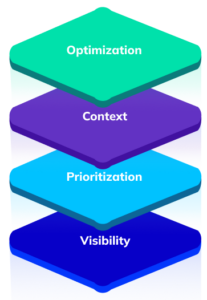
The Agentic Process Foundation framework has four layers: Visibility, Prioritization, Context, Optimization. They build in strict order. You can’t skip one. You can’t prioritize what you can’t see. You can’t give AI context about a process you haven’t modeled. You can’t optimize what you never modeled or prioritized. Visibility comes first. There’s no other place to start.
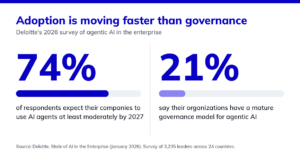
Deloitte’s 2026 State of AI in the Enterprise found that 74% of respondents expect their companies to be using agentic AI at least moderately by 2027. Only 21% say their organizations have a mature governance model for agentic AI.
Most organizations haven’t closed that gap. Not for lack of trying. The old path to visibility was broken in three places.
Manual modeling took days or weeks and needed a subject matter expert (SME). Even after the model existed, populating it with who’s accountable, how the work depends on other work, and which risk and compliance rules apply took just as long.
Process knowledge lived scattered: a spreadsheet here, a SharePoint doc there, a diagram somewhere else. No single place showed how any of it connected.
And once a model was finally done, keeping it current took constant manual work. Processes changed. Regulations changed. Standard Operating Procedures (SOPs) changed. Most organizations quietly skipped the whole effort. Nobody had a repository that could maintain itself.
That’s why visibility became the layer everyone skipped. Here’s how each legacy hurdle gets cleared, and how fast the foundation moves once they are.
How can organizations model business processes faster?
Modeling a process end to end used to take weeks. An SME. A whiteboard. A string of workshops nobody had time for. Even once the diagram was done, the harder part was still ahead: who’s accountable for each step, how the work depends on other work, which risk and compliance rules apply. That data is what makes a model useful instead of just a picture, and it took just as long as the model itself. Most organizations skipped it. Where system data exists, process mining enhances the model further: it discovers what’s actually happening straight from event logs, and surfaces the gap between what was designed and what’s really running.
Pia is the iGrafx AI-based Process Intelligence Assistant. Point it at the SOPs, diagrams, work instructions, transcripts from mapping meetings, even images of process documentation. It builds the model. It checks that model against your organization’s own standards and templates as it’s built.
To get that work into the Structured Process Repository, Pia uses iGrafx Access360. Access360 is the governed connection into the repository. Every request follows the user’s own permissions. Most integrations into a repository like this would only read from it. Access360 also writes: the model, plus the accountability, dependencies, and risk and compliance data that make it useful. Any write stays within those permissions. It is checked out and versioned exactly like a human edit. Pia’s changes don’t take a separate, less governed path into the repository just because Pia made them.
At iGrafx Connect North America in Washington, D.C., Moshe Dickerman of Ren Inc. described doing exactly this, and it caught the audience off guard. An LLM with no special training on Business Process Model and Notation (BPMN) drafted the model directly into BPMN format. Pia took it from there, building the diagrams and populating the repository with the underlying process data. A process model that normally takes weeks came together in minutes. Some tweaking was still needed, his words, but the foundation was there almost immediately.
Pia writes directly into the Structured Process Repository through Access360. Process mining adds its own discovery on top, straight from system data. Discovery doesn’t produce a side document someone has to reconcile later. It lands as governed data, in the one place it needs to live.
Establishing the single source of truth
The old failure mode wasn’t a lack of documentation. It was documentation everywhere at once. A spreadsheet on someone’s laptop. A Word doc in SharePoint. A Visio diagram in a folder three teams over. Each one accurate on its own, and none of them talking to each other. Nobody could trace how a change in one connected to a risk in another, because nothing connected them at all.
The Structured Process Repository fixes that. One place, everything connected: not just the model, but the accountability, dependencies, and risk and compliance data Pia captured alongside it. A spreadsheet can’t tell you how it depends on a diagram three teams away. A repository can. The relationship is part of the data, not something a person has to remember to check.
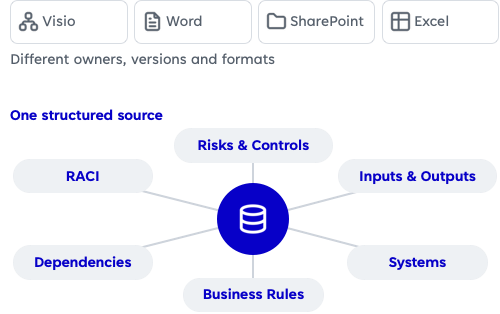
At iGrafx Connect North America, Kinsey Drury from Axos Financial described what that looks like in practice. Six disconnected systems, Visio, Word, SharePoint, Risk & Controls, Job Profiles, and Applications, brought into one governed source of truth. What used to surface at audit time now gets flagged continuously. The risk and compliance data isn’t sitting in a separate system waiting to be checked. It’s already part of the repository.
Risk and compliance data sits inside the repository’s objects, attached to the steps where the work happens. That is governance at the process level, which sets it apart from board-level Governance, Risk, and Compliance (GRC) tools. When AI agents act, it gets structured context: who is accountable, which rules apply, and what depends on what.
How do you keep the repository current, and put it to work?
The repository is only as good as it stays current. Processes change. Regulations change. SOPs get rewritten. The old fix was a re-baselining project: manual, occasional, usually a step behind by the time it finished.
Next, discovery agents will close that gap. They will check the Structured Process Repository against what’s actually running, and against regulation and SOP changes. When something no longer matches, they will surface it. The direction is a repository that maintains itself, with people approving updates instead of authoring them.
Keeping the repository current is half the job. The other half is making it useful to everyone who needs it. That is where Access360 comes in. It lets LLMs, AI agents, and business applications work with the repository, each within the requesting user’s own permissions. An LLM can query the repository, in plain language. Anyone in the business can ask how a process works and get the same answer back, without knowing how to read a BPMN diagram. The data stays in the repository, with no separate index for AI to search.
With Access360 in place, the tool asking the question doesn’t have to be the same for everyone. It shouldn’t be. One client chose to use both Pia and an LLM, deliberately. Pia stays inside the repository, so every employee can use it safely. An LLM connected through Access360 can reach further: other business systems as well as the repository. That reach goes to fewer people, on purpose. The right tool depends on how much reach the person needs. It doesn’t have to be a chat window, either. Salesforce could ask the repository a question directly, instead of a person opening iGrafx.
The Structured Process Repository becomes more than a system of record. It’s the most valuable operational asset the business has. Access360 is what makes it reachable, however the business chooses to ask.
What Visibility Unlocks, Once It’s Not Skipped
Process modeling used to mean three separate efforts. Map the process, with specialized resources and cross-functional teams pulled together for days, weeks, sometimes months. Populate it with who’s accountable and what depends on what, which took just as long. Keep it from going stale, a manual effort with no natural end point. Each one its own project, each one competing for time nobody had enough of.
Today, that same work is measured in minutes or hours. Pia drafts models from the documents you already have, and populates them with the accountability, dependency, and risk and compliance data that used to take just as long by hand. An LLM can draft from source material, then call Pia through Access360. Next, Pia will be able to call Access360 as well. Each works on its own and works better together. What used to require weeks of cross-functional time now happens inside a single working session.
Multiply that across every process in the business, and the repository stops being a collection of individual models. It becomes something else entirely: not a record of the business, but infrastructure the business runs on, and AI acts on, in real time.
The other layers were never slow. They were unreachable. You can’t prioritize what you can’t see end-to-end. You can’t give AI agents context about a process that was never fully modeled. Optimization only ever applied to the pieces that happened to get modeled, never the whole operation. None of that was a speed problem. It was a visibility problem. Now that it’s solved, Prioritization, Context, and Optimization aren’t waiting on anything anymore. They’re finally possible.
Once you can see the whole operation end to end, the question changes. It is no longer only what to automate or hand to AI agents. It is whether the business should change how it runs first. That is where Prioritization comes in. It lets you simulate changes before they go live, so you decide where to apply automation and AI with the full picture in front of you.
Deloitte found that 74% of respondents expect to use AI agents at least moderately by 2027. Only 21% say their organizations have a mature governance model for agentic AI. That’s the gap. Seeing the whole operation end to end is where closing it starts. Not more oversight. A foundation the business can actually see, act on, and defend.
See what your own operation looks like once it’s actually visible. Visit www.igrafx.com to schedule a demo or start a free trial of Pia.