

AI agents are now part of your business processes. They make decisions, take actions, and move work forward without waiting for human approval. That’s powerful. It’s also a problem if you can’t see what they’re doing or prove they stayed within the rules.
The Agentic Process Foundation is the operational layer that makes trusted AI possible. It gives agents the process visibility, context, and guardrails they need to act correctly inside real enterprise workflows. It’s built from four layers: visibility, prioritization, context, and optimization.
The reason it exists is simple. Every business process now has three participants: people, automation, and AI agents. Most organizations have no unified view across all three. When AI acts without that context, outcomes become unpredictable and compliance becomes impossible to prove.
The sections below explain what it is, why it exists, how it works, and where it matters most.
Why can’t organizations trust their AI agents yet?
The Agentic Process Foundation is the operational framework that allows organizations to scale trusted AI across their business. It exists because AI agents do not fail primarily because the technology is wrong or doesn’t work. They fail because the organizations deploying them lack visibility into how work actually operates, the context AI needs to act correctly, and the information required to prove it behaved within the rules.
Most business processes now involve three participants working together: people, automation, and AI agents. Yet in many organizations, no single view captures how those participants interact, where decisions get made, or where accountability sits. The Agentic Process Foundation closes that gap by embedding risk and compliance directly into the process and giving AI the guardrails it needs to operate reliably.
Put simply, it is the difference between having AI and being able to trust it.
Why are so many agentic AI projects failing?
AI agents need a process foundation because adoption is outpacing the ability to manage it. The technology is moving into production faster than most organizations can establish the operational visibility, execution context, accountability, and validation needed to trust it.
The data makes the problem impossible to ignore.
42% of enterprises already have AI agents in production. The adoption is real and accelerating. But only 26% have successfully scaled beyond pilots into deployment they can trust. Nearly half of enterprises have AI agents running. Only one in four can trust what those agents are doing at scale.
That gap between deploying AI and being able to trust it is where most organizations are stuck.
75% of leaders rank compliance and auditability as top requirements for AI deployment. They know they need to prove their AI operated within the rules. Most cannot.
Gartner predicts that over 40% of agentic AI projects will be canceled by the end of 2027, citing escalating costs, unclear business value, and inadequate risk controls.
That is not a technology problem. That is a foundation gap. And it is ultimately a trust problem. Organizations lack confidence that AI can operate accountably, within defined boundaries, and in a way they can defend to regulators, auditors, and leadership.
In practice, that foundation gap consistently appears in four areas:
No basis for deciding where AI belongs. Without visibility into how work executes, organizations cannot determine where AI should, or should not, be applied.
No complete operational picture. There is rarely a single view of how work flows across people, automation, and AI agents, so decisions get made with partial information.
No runtime context. Once deployed, AI frequently lacks the roles, accountability, approvals, and escalation paths it needs to act consistently inside a real workflow.
No way to validate outcomes. Organizations cannot predict operational impact or confirm results before changes reach production.
How is AI fundamentally changing the way work gets done?
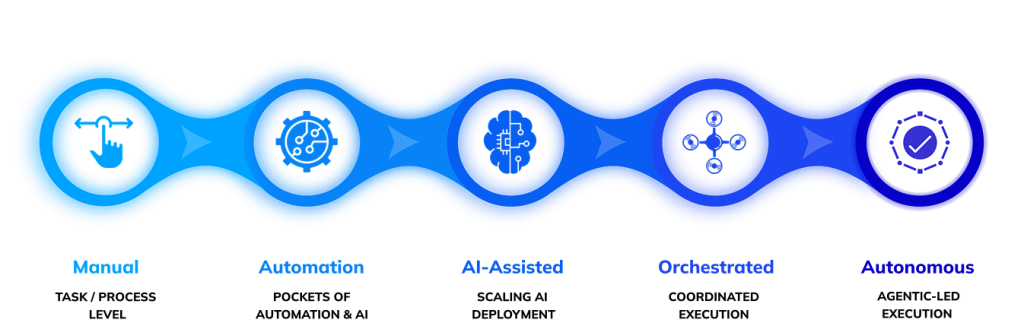
Every organization starts in the same place. Manual processes. Task by task. Person by person. Process knowledge lives in people’s heads, in documents, in institutional memory.
Then automation arrives. Pockets of RPA, workflows, rule-based execution. This is where most organizations are today. Siloed automation, no end-to-end view, no shared foundation. The scaling trap was set here, most organizations just didn’t know it yet.
Then AI enters. Not replacing automation but layering on top of it. Scaling across processes that were never designed to be connected. The foundation gaps become dangerous at this stage.
Coordinated execution across people, automation, and AI agents is where the foundation becomes essential. You cannot orchestrate what you cannot see. You cannot trust what you cannot prove.
The organizations reaching autonomous, agentic-led execution safely are the ones who built the foundation before they needed it.
That foundation has four layers.

What are the four layers of the Agentic Process Foundation?
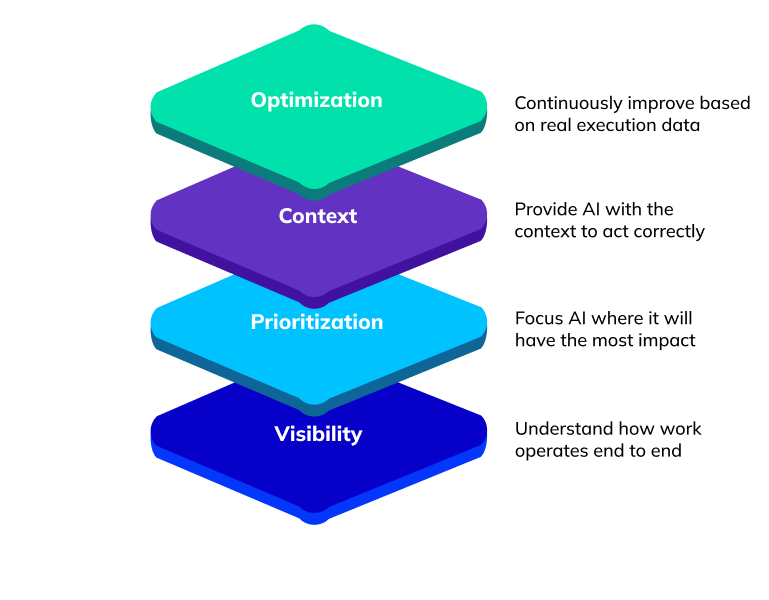
The Agentic Process Foundation is built from four operational layers that build on each other: visibility, prioritization, context, and optimization. Each layer addresses one of the gaps above, and together they create the foundation required to scale trusted AI.
1. Visibility
Visibility means building a real-time operational picture of how work actually executes. This is not a one-time snapshot but a continuously updated view across people, automation, and AI agents, assembled from systems, process diagrams, standard operating procedures, and live workflows. Without it, every downstream decision about AI rests on guesswork.
2. Prioritization
Prioritization means deciding where automation or AI should, and should not, be applied. Business impact drives that decision. Business impact drives the prioritization. By using AI to assess the design, and modeling outcomes in advance with Discrete Event Simulation (DES), organizations can focus investment on the highest-value opportunities first, rather than discovering through failed pilots which use cases were never viable.
3. Context
Context means packaging process knowledge (roles, risks, and compliance requirements) and delivering it to AI agents at runtime, not just at design time. This is what allows AI to act correctly within a workflow, not just technically but operationally, respecting the approvals, accountability, and escalation paths the business depends on.
4. Optimization
Optimization means comparing expected versus actual execution continuously. This closes the feedback loop that every AI deployment needs but few have, surfacing drift between how a process was designed to run and how it actually runs once AI is involved. Optimization is also part of the continuous improvement process; feeding runtime information to Design and Simulation efforts to deploy the next improvement.
Each layer builds on the last. Together they create the operational foundation required to scale trusted AI.
Where does the foundation matter most?
Trust is no longer an aspiration. It is an operational requirement. When AI participates in a regulated workflow, the organization must be able to show that it operated within policy, every time.
Banking and Financial Services
In banking and financial services, regulators expect full transparency around credit decisions, fraud detection, and risk assessments. AI outputs must be traceable under SR 11-7 and Basel guidelines. Not just accurate, but provably so.
Insurance
In insurance, every automated underwriting and claims decision faces legal scrutiny. It must be explainable to regulators, auditors, and policyholders, especially as AI takes on a larger role in decision support.
Healthcare and Pharma
In healthcare and pharma, clinical AI must meet FDA and HIPAA standards. Diagnostic and treatment recommendations require documented, auditable reasoning before deployment. Innovation cannot come at the expense of patient safety.
Manufacturing
In manufacturing, ISO and safety certifications require documented process logic. AI-driven quality and operational decisions must be reproducible and defensible.
Different industries. Different regulators. Same question. How do you deploy AI at scale while maintaining the auditability required to be trusted, by regulators, auditors, and your own leadership?
What makes the Agentic Process Foundation different?
Traditional business governance and GRC applications manage compliance above the process. Policies are defined, controls are checked, and audits happen after the fact. The Agentic Process Foundation takes a different approach. Accountability and auditability are embedded directly into the process, before and during execution, not applied on top of it afterward.
| Dimension | Traditional Business Governance | Agentic Process Foundation |
|---|---|---|
| Focus | Compliance managed above the process | At the process level across people, automation, and AI where they perform |
| Compliance | Added afterward as a separate layer | Embedded directly into the process |
| Deployment Decision | Tested after deployment | Simulated before commitment |
| Context for AI | Provided at design time | Delivered at runtime |
| Feedback loop | Periodic Review | Continuous expected vs. actual comparison |
| Process Repository | Fragmented across systems, documents, and spreadsheets | Single source of truth for process knowledge, visibility, prioritization, context, and optimization |
The distinction matters because non-deterministic decisions happen faster than periodic reviews can catch. Embedding accountability into the process is what makes trust provable rather than assumed.
Why do enterprises choose iGrafx?
iGrafx has helped regulated enterprises ensure how work executes is accountable and auditable. That foundation becomes even more critical as organizations move from automation to AI-driven operations.
Embedded Risk & Compliance
Accountability, auditability, and compliance built directly into every process, not added afterward as a separate layer. Not a checklist. A foundation.
Simulation Before Commitment
First, decide whether AI or automation belongs. Then prioritize which delivers the greatest business impact. Then validate it performs as expected before deployment. Simulation makes all three possible before any commitment is made.
Structured Process Repository
A governed system of process intelligence connecting processes, teams, controls, and AI into a single trusted foundation. This is what gives AI the context it needs to act correctly. And what gives your organization the proof it needs to demonstrate it did.
These three capabilities are what make iGrafx the foundation that makes AI trustworthy. Built in. Validated before commitment. Proven at scale.
Where do you start?
The starting point depends on where you are. But the question is always the same. Can you trust what your AI is going to do, or what it is already doing?
The CIO needs to know AI is operating correctly across every system it touches. The Chief Risk Officer needs to prove it stayed within the rules. The transformation leader needs to scale without the wheels coming off.
Different roles. Different pressures. Same foundation.
The organizations getting this right are building that foundation now, before they need it at scale. The ones that wait are the ones Gartner predicts will cancel their AI programs by 2027.
You don’t have to be one of them.
Request a demo or contact our team to start building your Agentic Process Foundation today.
Frequently Asked Questions
What is the Agentic Process Foundation?
The Agentic Process Foundation is an operational layer that gives AI agents the visibility, context, and guardrails needed to act reliably inside
enterprise workflows. It is built from four layers: visibility, prioritization, context, and optimization. Organizations use it to deploy AI accountably and scale beyond pilots.
Why do so many agentic AI projects fail?
Gartner predicts over 40% of agentic AI projects will be canceled by the end of 2027, citing escalating costs, unclear business value, and inadequate risk controls (Gartner, 2025).
The failures usually trace back to operational readiness rather than the technology. Organizations deploy AI faster than they can manage it.
How is the Agentic Process Foundation different from traditional business governance?
Traditional AI governance applies compliance as a checklist after the fact. The Agentic Process Foundation embeds risk and compliance directly into the process, validates outcomes
through Discrete Event Simulation (DES) before deployment, and delivers context to AI at runtime rather than only at design time.
Which industries benefit most from the Agentic Process Foundation?
Regulated industries benefit most, including banking and financial services, insurance, pharma and biotech, healthcare, and manufacturing. In these sectors, auditability and accountability are operational requirements, so embedding compliance into the process is essential before AI acts.
What are the four layers of the Agentic Process Foundation?
The four layers are visibility (a real-time picture of how work executes), prioritization (deciding where AI should and should not be applied, based on business impact, before any commitment), context (delivering roles, accountability, and compliance requirements to AI at runtime), and optimization (continuously comparing expected versus actual execution).